
Checking for a Warrant in Killingly
Before searching, write down the full legal name, any former surname, birth year, the originating town, a court notice, docket or ticket number, and any known date. These details sort out look-alike names in Killingly. They also spare you from handing sensitive identifiers to some unofficial service.
- Open the Judicial Branch VOP search and select Killingly as the town.
- Choose Danielson GA as the court location when the matter is an adult Part B case.
- Read the FTA warning and other exclusions before interpreting a result.
- Use the criminal and motor-vehicle lookup for docket context.
- Call Danielson at 860-779-8480, then the resident trooper or Troop D for police questions.
Treat the public pages as leads only. In Killingly, the clerk confirms the court order, and police confirm only what falls within their own service or report role.
Killingly Warrant Search Through Danielson
Killingly and Danielson are not the same search. Killingly is the town named in the VOP filter. Danielson is a borough inside Killingly, and it also serves as the location label for Superior Court Geographical Area No. 11. Picking the town and court fields with care trims an overly broad Killingly result.
The courthouse sits at 120 School Street, Danielson, and the clerk's public line is 860-779-8480. Adult misdemeanor, Class C through E felony, motor-vehicle, and infraction matters from Killingly all route there. No town record office keeps a parallel adult criminal warrant docket.
Killingly Police and Municipal Court
Killingly relies on a resident state trooper rather than a standalone municipal police department for this route. The official county contact material lists the Killingly Resident State Trooper at 185 Broad Street, Danielson, CT 06239, phone 860-779-3900. That contact fits a recent complaint, a question about service, or a police-held report. It is not the office for court answers. Killingly has no municipal criminal court of its own. A Connecticut Superior Court judicial authority issues the adult court warrant, the clerk at Danielson maintains the file, and State Police can execute the order. So questions about current bond, an appearance, a recall, or docket status belong with Danielson rather than Town Hall.
Killingly Warrant Service at Troop D
Troop D is the State Police troop that serves Killingly from 55 Westcott Road, Danielson, CT 06239, public phone 860-779-4900. The troop and the resident trooper are related channels but not interchangeable with the Superior Court clerk. The official State Police troop directory lists the regional contact.
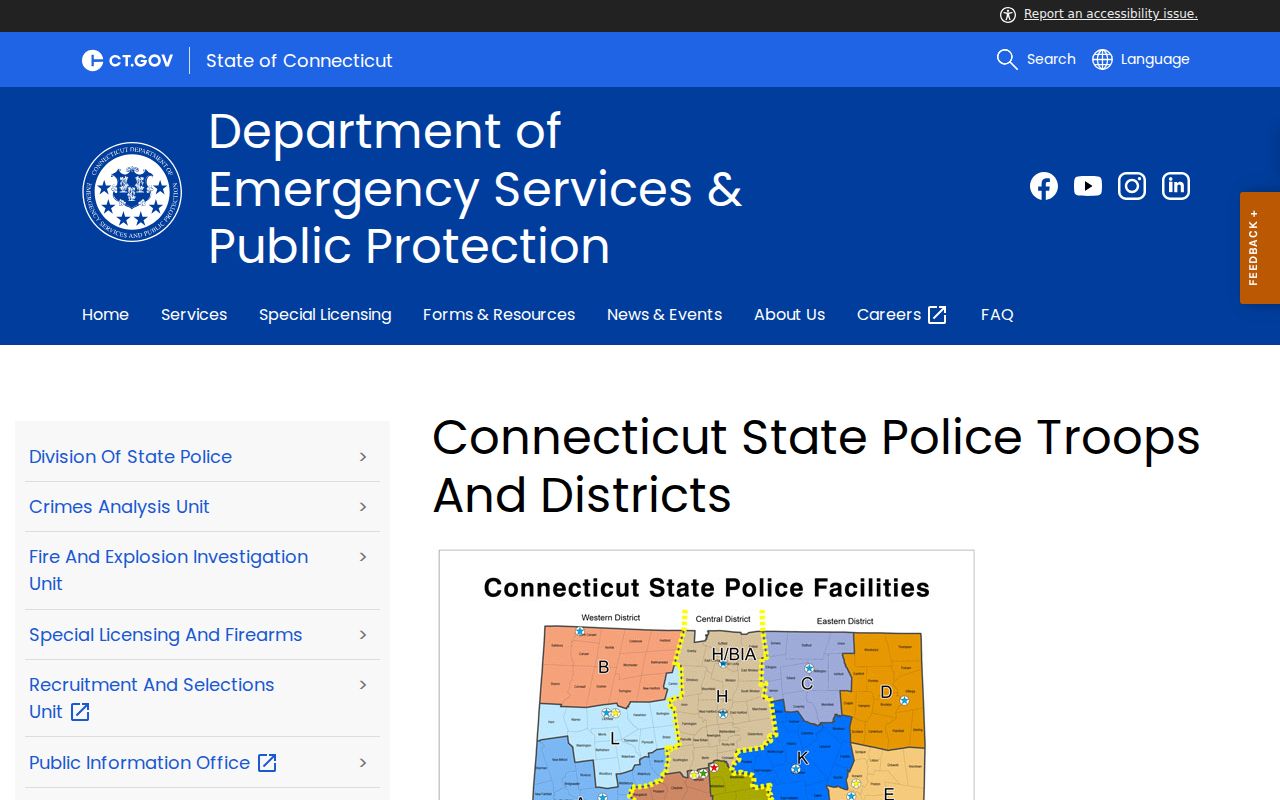
The directory works for a direct call about service or a recent State Police investigation in Killingly. It offers no public Troop D warrant roster. For a court-status answer, jot the docket number and go back to Danielson GA 11.
Killingly Warrant Types
The type of Killingly warrant shapes which public tool might hint at it and which office must confirm it. Every adult court category stays inside Connecticut Superior Court.
| Type | Basis | Killingly route |
|---|---|---|
| Arrest warrant | Judicial probable-cause finding | Danielson and investigating police agency |
| Bench warrant | Appearance or court-order problem | Issuing Superior Court |
| Failure to Appear | Missed criminal, traffic, or infraction date | Danielson confirmation because public results are paused |
| Violation of Probation | Alleged breach of probation conditions | VOP search, court, and probation |
| Order to Incarcerate | Fine or sentence context | Court confirmation |
Connecticut also issues capias for a witness or defendant who violates an appearance order under C.G.S. §54-2a. Capias pro fine is not the standard term for a Killingly traffic matter.
Killingly Warrant Search Limits in 2026
The VOP search takes a last name, optional first name, town, court location, birth year, and a plus-or-minus year range. It wants at least two surname letters. No public account, payment, Social Security number, or full date of birth is requested for a Killingly lookup.
Search limit: The Judicial Branch currently says Failure to Appear warrants will not be displayed until further notice.
The page itself warns that not all warrant types appear and that results are informational. A blank Killingly search cannot clear an FTA, a sealed matter, a juvenile or youthful-offender case, or another excluded category. The criminal case lookup can hand you a docket or date. Its own disclaimer says it is not the official record.
Inside a Killingly Warrant Record
A public entry may tie a name to a court, docket, warrant category, underlying case, issue or service information, and a release condition. The exact fields vary. It depends on the record and on what the Judicial Branch may disclose about a Killingly matter.
| Docket number | A location, case-type, year, number, and suffix pattern such as D11-CR-26-00000-S. |
|---|---|
| Name | The public defendant identity, compared with birth year when available. |
| Town and court | Killingly as origin and Danielson GA as location when applicable. |
| Warrant type | VOP, FTA, OTI, arrest, or bench process when public. |
| Underlying matter | Charge, probation claim, ticket, or other case reason. |
| Status and bond | Only the current information the source is authorized to show. |
Give the clerk a docket number when you call about a Killingly warrant. A name alone can match another person, and it proves neither identity nor current warrant status.
Killingly Traffic Warrant Timeline
A Killingly traffic citation starts at the statewide Centralized Infractions Bureau. The online ticket tool asks for the full ticket number, the check digit, and the first three letters of a surname or company name. Electronic complaints may take three to five business days to show up. Handwritten tickets may take five to seven.
- Pay, plead not guilty, or use online review if eligible by the answer date.
- Call CIB at 860-263-2750 when the answer date has passed.
- Once transferred, ask Danielson GA 11 whether an FTA or court process began.
- Follow the clerk's reopening, appearance, payment, or bond instruction.
- Confirm any separate DMV restoration before driving.
A court reopening charge of $60 may apply, and restoration after suspension carries a separate $175 DMV charge. Do not guess at payment to CIB once a Killingly case has transferred to Danielson.
How Killingly Warrants Fit the County System
A Killingly complaint may start with the resident trooper or Troop D. A Superior Court judicial authority then reviews and issues an adult warrant. Danielson's clerk keeps the court file, and PRAWN distributes warrant information to authorized agencies. Connecticut has no county sheriff or municipal criminal-court layer.
Warrant flow: Killingly Resident State Trooper or Troop D › Superior Court GA 11 at Danielson › PRAWN for authorized agencies
The wider structure is laid out in the Windham County warrant records overview. At the Killingly level, one distinction matters most: police hold information at the resident-trooper or troop level, while the court controls the warrant record at Danielson.
Killingly Warrant Records From the Right Office
Killingly warrant records sit with different offices. A narrow request works best. State Police keeps agency reports and service-related records. The Danielson court clerk holds the adult criminal and motor-vehicle case files for Killingly matters, along with present warrant status. The town clerk is not the adult criminal clerk. A general Freedom of Information request cannot override court confidentiality rules either. Before you file anything in Killingly, separate the document from the legal question. A police incident report may describe an arrest. It will not tell you whether a judicial warrant is still active in Killingly today. A docket entry shows a court event, not the signed warrant application itself. For current status, ask the clerk directly with the docket number. For a report, identify the date, place, incident number, and agency. Connecticut's FOI guidance says no universal request form exists. Describe the record, the date, the incident or docket number, and your preferred format. Ask about copying charges before ordering a long file. Do not assume the standard police-copy limit controls certified judicial records. No certified-copy fee for a Killingly warrant is published. Ask the Danielson clerk to quote the amount and format. The agency can withhold active-investigation, witness, safety-sensitive, erased, juvenile, youthful-offender, or sealed material. A refusal is not proof that no warrant exists. If part of a Killingly record is unavailable, ask whether a public docket entry or administrative portion can be released. Then confirm warrant status through the issuing court rather than inferring it from missing pages.
Killingly Warrant Records and Public Access
Connecticut's Freedom of Information Act, C.G.S. §1-200 et seq., reaches the Judicial Branch only for administrative functions. Other public agencies fall squarely under it. Judicial records follow court access rules instead. So a public lookup for Killingly warrants helps, but it stays incomplete.
Access rules: C.G.S. §1-210 provides access subject to exemptions; C.G.S. §46b-124 protects juvenile matters; and C.G.S. §54-2a addresses bench warrants and capias.
The issuing court or agency decides what gets released. Use public information to track your own or a relative's case and find the right office. Never act on another person from an online Killingly result.
Resolving and Confirming Killingly Warrants
Call Danielson before you travel anywhere. Ask which court issued the warrant, whether an appearance or bond is required, and whether counsel can arrange a motion, walk-through, or voluntary surrender. Killingly itself posts no bond counter, surrender window, amnesty program, or warrant-clearance form. The court is the place to ask.
Important: Seek legal advice before appearing and do not treat a police visit or online absence as a court-ordered recall.
Keep every piece of paper. Hold on to the order, release paperwork, receipt, and docket number once the judge acts or a Killingly warrant is served. Ask the clerk when CRMVS, PRAWN, and the public record will update. For a ticket case, keep the reopening proof and confirm DMV restoration separately, since written confirmation beats disappearance from an incomplete Killingly search.